艺术史只保留真正改变舞台理解的内容。能确认的留给历史,无法确认的留给沉默。Art history remains only where it changes theatrical understanding. What can be established stays with history; what cannot be known remains silent.
宫廷中的观看The Court of Looking
宋徽宗赵佶(1082–1135)既是北宋皇帝,也是书画创作者、收藏者,并深度参与宫廷艺术制度与品评标准的塑造。徽宗朝的艺术世界不能被压缩成一种单一“宋代审美”:画学、宫廷收藏、题画诗书写、精密写生、书法与祥瑞图像彼此交叠,皇帝个人的艺术判断也直接进入制度。Emperor Huizong (1082–1135) was a ruler, painter, calligrapher and collector who also played an unusually direct role in shaping courtly artistic institutions and standards of judgement. The art of his reign cannot be reduced to a single “Song aesthetic”: the court brought together painting education, imperial collecting, close observation of nature, poetic inscription, calligraphy and images of auspicious order, with the emperor’s own taste operating inside that system.
1112
年的《瑞鹤图》把这个世界具体化:画面下缘只露宣德门屋脊,十八只鹤盘旋空中,两只停驻鸱尾;建筑以界画方式绘出,大片青色天空与白鹤形成极不寻常的视觉秩序。画后又有赵佶以瘦金书写下的题记与诗文。它把图像、书法、诗文与祥瑞叙事组织在同一件作品中,也提醒我们:宋徽宗时代的宫廷绘画既有精工与华彩,也有宫廷制度与祥瑞观念的介入,绝不能简单等同于“淡雅”或“留白”。
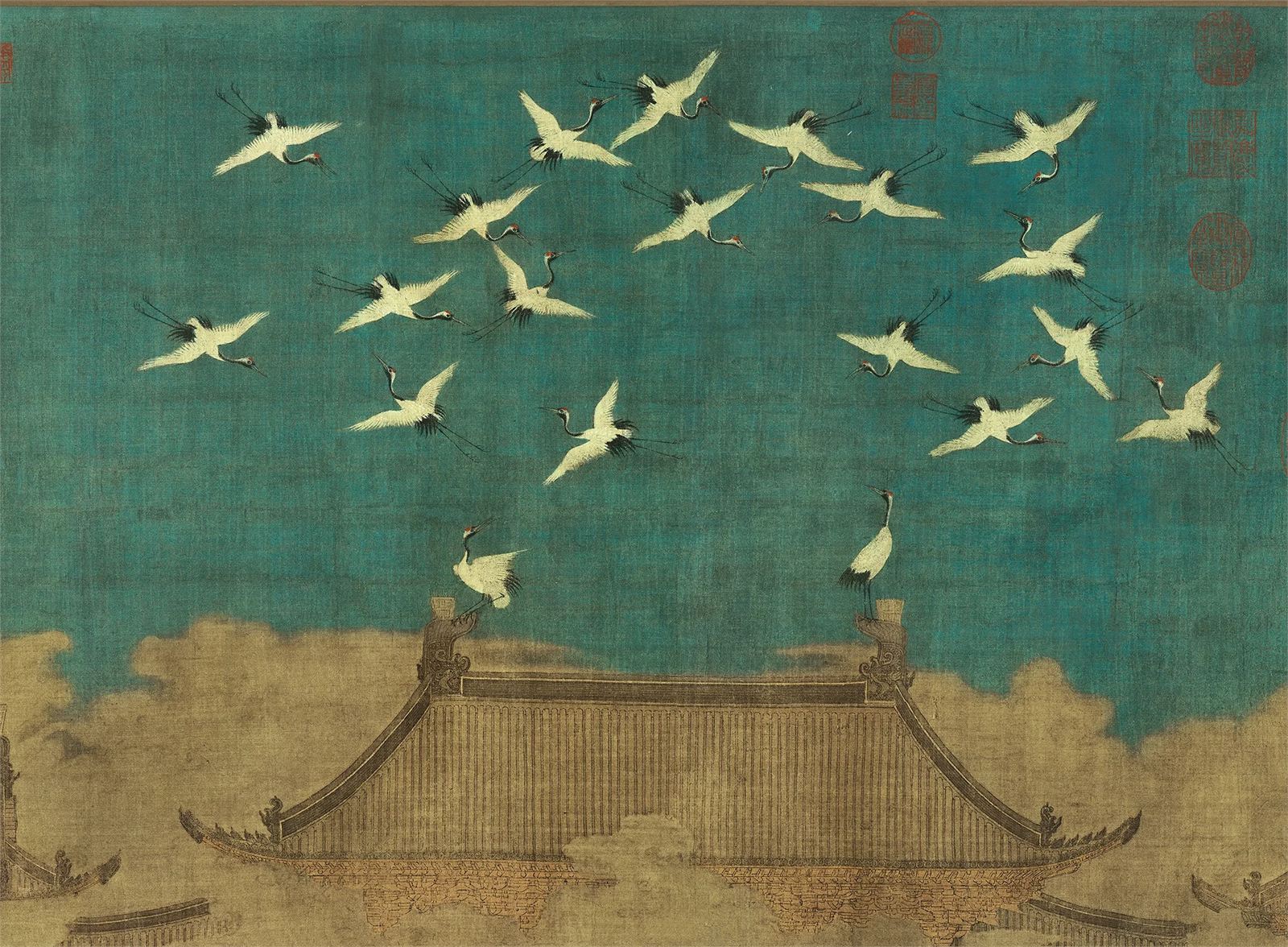
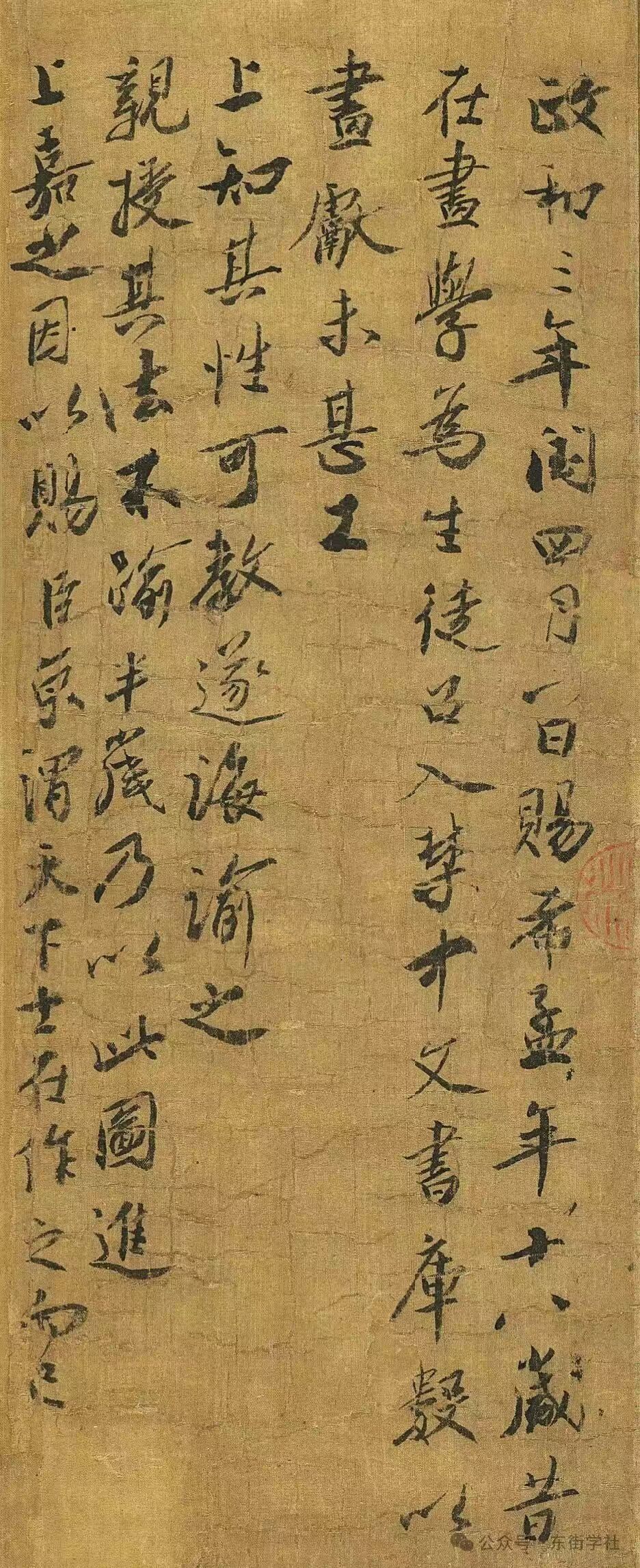
翌年,蔡京在《千里江山图》卷后留下政和三年(1113)题跋。题跋写下“希孟”之名,称其十八岁、曾在画学为生徒,并记载徽宗曾亲自“诲谕”其画法。这段题跋,是今天认识这位年轻画家最重要的同时代文字之一。(配题跋)Auspicious Cranes, dated 1112, makes that world unusually visible. Only the upper
roofline of the Xuande Gate enters the bottom of the image; eighteen cranes wheel across a blue sky
while two perch on the roof ornaments. The architecture is handled in jiehua — ruled-line architectural
painting — and the painting is followed by Huizong’s own inscription and poem in his distinctive Slender
Gold (shoujin) script. Image, calligraphy, poetry and a courtly narrative of auspicious order are held
within a single object. The work is also a useful corrective to the cliché that Song art was uniformly
pale or minimal: court painting could be meticulous, highly coloured and deliberately
constructed.
In the following year, 1113, Cai Jing added a colophon to A Thousand Li of Rivers
and Mountains. It names “Ximeng,” states that he was eighteen, records that he had been a student in the
painting school, and says that Huizong personally instructed him. This colophon remains one of the most
important contemporary sources for what we know of the young painter.
一个名字与一卷留下来的画Ximeng
画卷本身没有作者落款。故宫博物院现以“王希孟”著录此卷;1113 年蔡京写在卷后的题跋,只留下“希孟”二字。The painting itself carries no artist’s signature. The Palace Museum catalogues the work today under the conventional name Wang Ximeng; Cai Jing’s colophon of 1113 records simply “Ximeng.”
关于这个少年,我们知道的几乎都在那几行字里:十八岁,曾在画学为生徒,徽宗见其“性可教”,亲自诲谕,不逾半岁,进呈此卷。再往后,籍贯、卒年、死因和此后的人生,史料没有再说。清代以后关于早逝的说法,只能作为后世传闻,不能倒写成北宋事实。
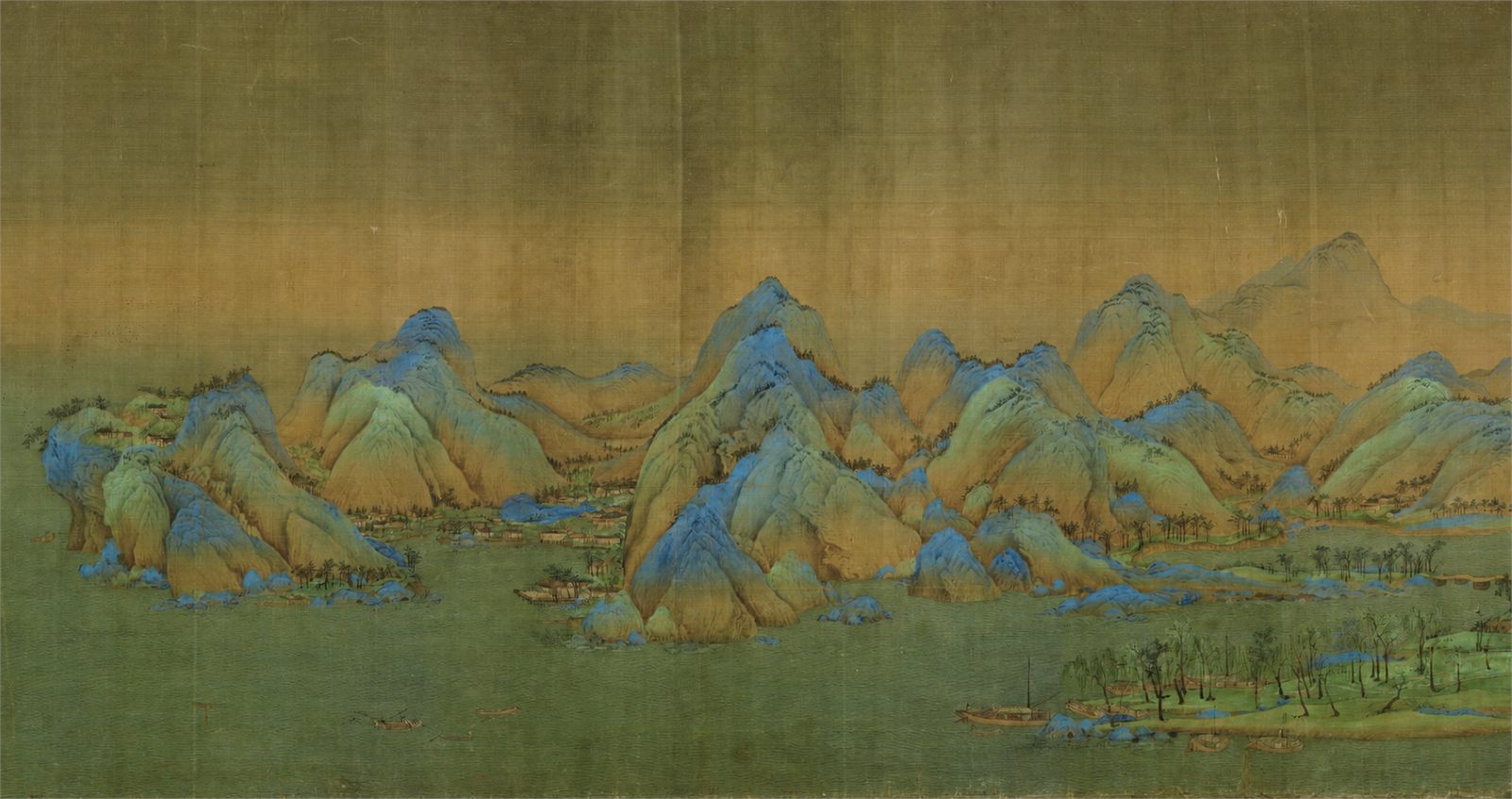
可这卷画一点也不沉默。纵
51.5 厘米,横 1191.5
厘米,近十二米山水铺展开来:远看,群山与江水一气奔流;近看,人物细如豆点仍各有姿态,水纹一笔笔写出,屋舍、桥梁、水磨与舟船藏在山川褶皱里。宏阔没有牺牲细节,细节也没有拖住山河的气势。
陈丹青谈《千里江山图》时,把它近乎不可思议的气势落在“十八岁”上。成熟画家往往越来越懂得减法,懂得省略、收束与留白;“希孟“却一路做加法——山还要更高,水还要更远,路径、屋舍、舟船、人物、水纹,都不肯轻易舍去。重要的不只是完成近十二米长卷所需要的体力,更是“敢”:经验还没有反复提醒他“不要太满”,雄心却已经大到要把千里收进一卷。
这不是“年轻所以不懂规矩”。恰恰相反,如此巨制需要惊人的秩序、耐力与控制。真正属于十八岁的,是那份尚未学会把世界缩小的胆量——既要辽阔,也不肯放过细节。
一个人的生平几乎消失,一幅画却把他的十八岁保存到今天。我们不知道”希孟“后来去了哪里,却仍能站在九百多年前那份雄心面前:天地如此辽阔,而他竟真的想把它画下来。Almost everything securely known about the young painter is contained in those few
lines: he was eighteen; he had been a student in the painting school; Huizong judged him teachable,
instructed him personally, and within less than half a year Ximeng presented the scroll. Beyond that —
birthplace, date and cause of death, the rest of his life — the record falls silent. Later stories of an
early death belong to later tradition, not to the surviving Northern Song evidence.
The painting,
however, is anything but silent. Measuring 51.5 by 1,191.5 centimetres, it unfurls nearly twelve metres
of terrain. From a distance, mountains and water gather into a single sweep; close up, tiny figures
remain animated, ripples are drawn stroke by stroke, and houses, bridges, watermills and boats are
tucked into the folds of the landscape. Immensity never sacrifices detail; detail never arrests the
movement of the whole.
When Chen Danqing discusses A Thousand Li, he locates something almost
impossible about it in Ximeng’s age: the nerve of eighteen. Mature painters often learn subtraction —
what to omit, compress or leave open. Ximeng seems to move the other way. He keeps adding: higher
mountains, farther water, more paths, houses, boats, figures and ripples. The point is not only the
stamina required to complete a scroll nearly twelve metres long, but the audacity to attempt it before
experience has repeatedly taught the eye to hold back.
This is not an argument that youth means
indiscipline. On the contrary, a work on this scale demands formidable order, endurance and control.
What feels eighteen is the refusal to make the world smaller — the desire for immensity without
surrendering detail.
A life almost disappears from the record; one painting keeps his eighteenth
year vividly before us. We do not know what became of Ximeng. What remains is the scale of the attempt:
the world was immense, and he tried to paint it.
为什么是青绿Qinglü
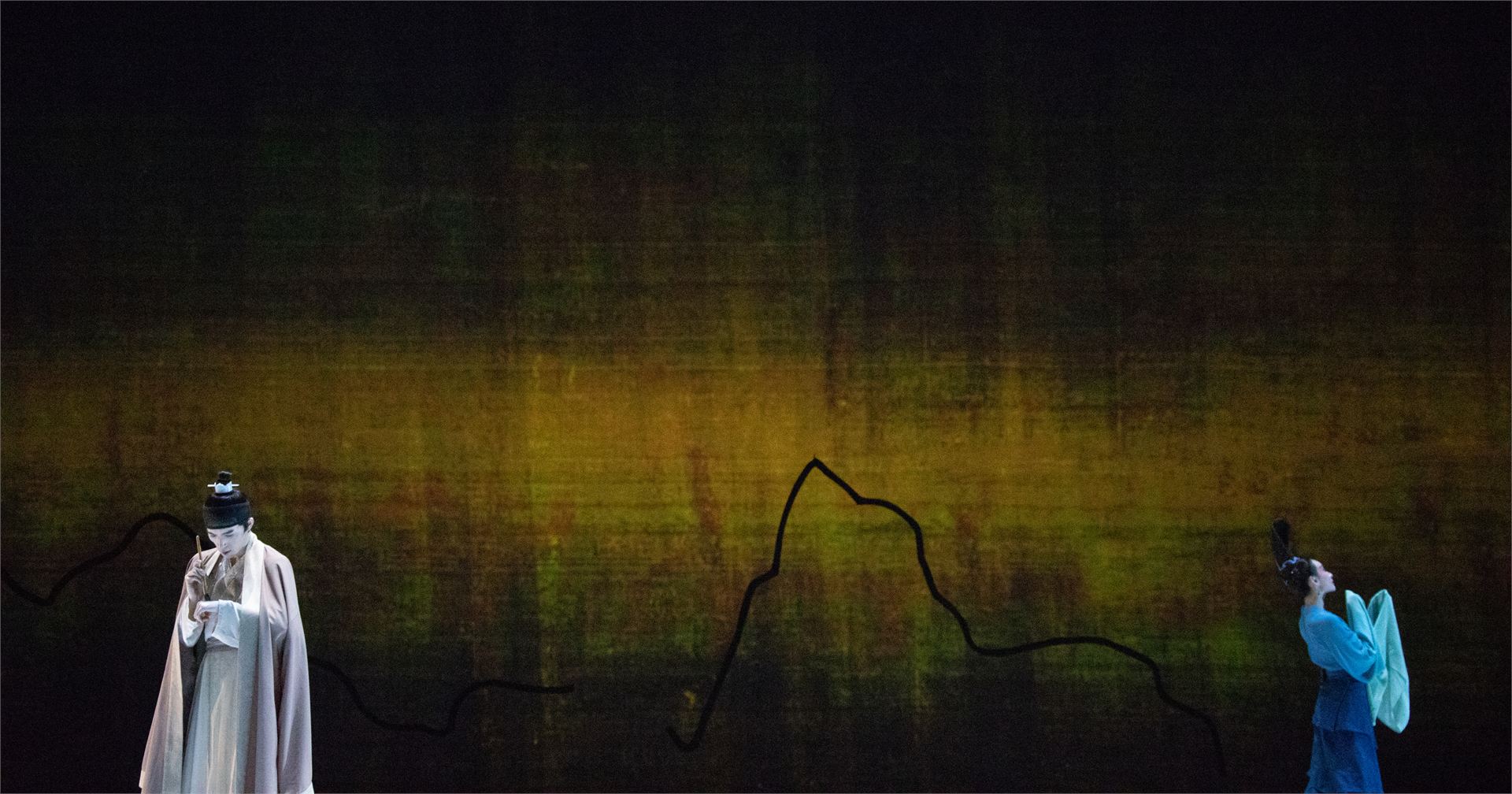
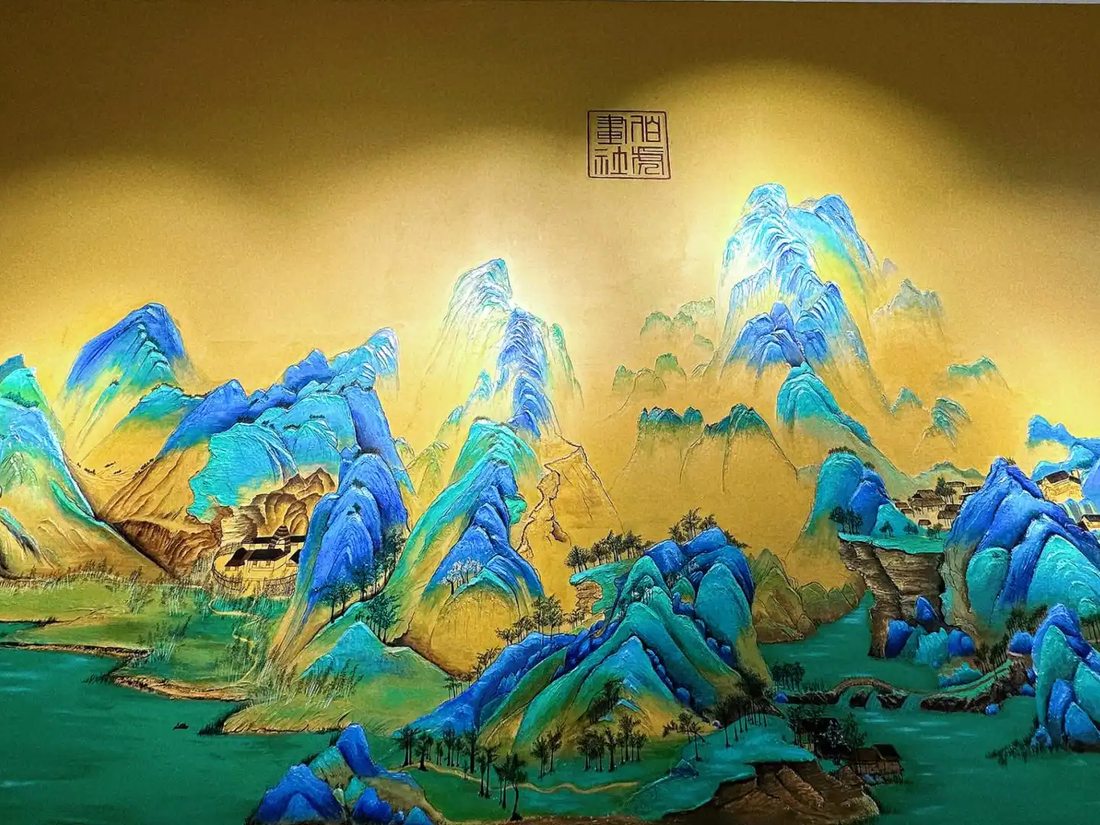
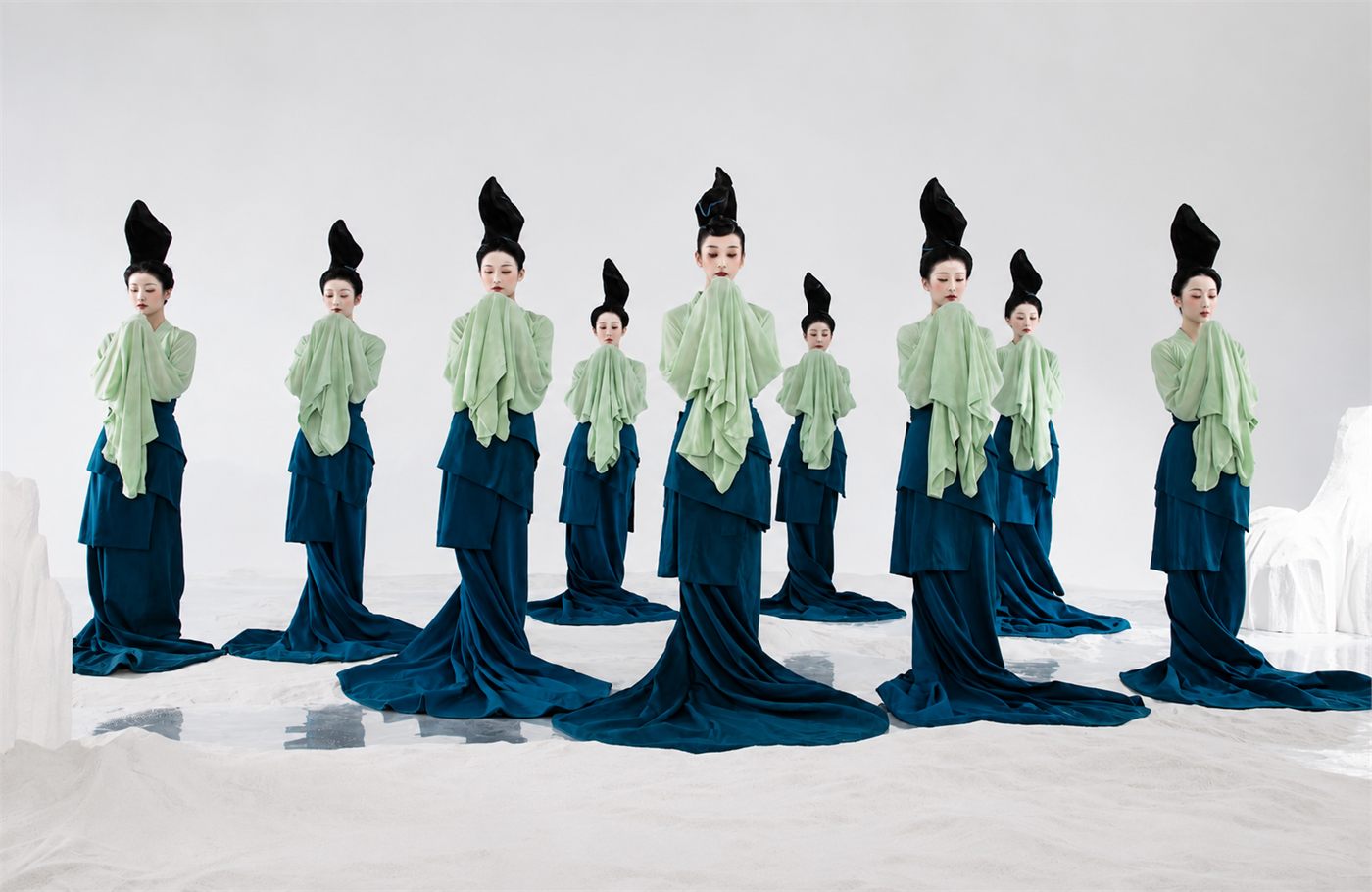
“青绿”先是一种中国山水画传统,然后才成为舞台角色的名字。Qinglü names a long tradition of Chinese landscape painting before it names a figure on this stage.
“青绿山水”是对一类以青、绿矿物设色为显著特征的山水画传统的概称,其历史很早,通常可上溯到隋唐。早期传世实物有限,从隋唐到宋代并不存在一条可以被完整复原的连续谱系。到北宋,《千里江山图》在纵
51.5 厘米、横 1191.5
厘米的绢本手卷上,把青绿设色推向极为宏阔而精密的规模。
所谓石青、石绿,不是“蓝色石头”和“绿色石头”的简单同义词,而是以蓝铜矿(azurite)、孔雀石(malachite)等矿物为原料制备的传统颜料。矿料要经过选择、粉碎、研磨、淘洗与分级,颗粒大小、胶媒与层层敷色都会改变色相、覆盖与光泽。《千里江山图》每层颜料的具体先后,目前仍不能由针对本卷的专项技术研究完整回答。
青绿山水也从来不是“先画完一幅水墨,再把蓝绿涂上去”的二步法。勾勒、皴染、墨色、赭色与矿物设色共同组织山体、树木、水纹和远近。《千里江山图》的色彩浓丽而不单调,故宫著录特别强调它在蓝绿色中求变化,并以赭色相衬,形成近于宝石的视觉强度。
《只此青绿》从这里取走的不是某一个色号,而是颜色背后的材料性、层次、重量与时间。到了舞台上,这些关系重新发生在身体、衣料、光和空间之间。Qinglü shanshui — usually rendered as “blue-and-green landscape” — refers to
traditions in which blue and green mineral colours play a conspicuous role. The tradition reaches back
at least to Sui and Tang precedents, though surviving early works are few and the lineage cannot be
reconstructed as one seamless continuum. In the Northern Song, A Thousand Li of Rivers and Mountains
carries this chromatic language across a silk handscroll measuring 51.5 by 1,191.5
centimetres.
Shiqing (石青) and shilü (石绿) are prepared mineral pigments, not simply names for blue
and green stones. Traditionally made from mineral materials such as azurite and malachite, they involve
selection, crushing, grinding, washing and grading; particle size, binder and layering alter hue,
opacity and lustre. The exact sequence of paint layers in this particular scroll has not been fully
established by object-specific technical study.
Blue-and-green landscape is not a two-step
procedure in which an ink painting is finished and colour merely laid on top. Outline, texturing, ink,
warm earth tones and mineral colour work together to construct rock, vegetation, water and distance. The
Palace Museum emphasises the scroll’s variations within blue and green and its reddish-brown accents,
producing a brilliance often compared to gemstones.
What The Journey carries into the theatre is
not a colour swatch but a material logic: density, layering, weight and time, newly felt through bodies,
textile, light and space.

手卷如何容纳时间A Handscroll Holds Time
传统的手卷观看并不以“一次看全”为目标。Traditional handscroll viewing was never about taking in the whole image at once.
传统中国手卷通常置于案上,从右向左逐段展开;看过的部分在右侧卷回,下一段才从左边慢慢出现。一次进入视野的只是有限范围。刚刚看过的景物退入记忆,尚未展开的山水仍在未知之中——观看因此不是面对一面“窗”,而是一段真正发生在时间里的行程。
《只此青绿》也保留这种显现与消隐:人物、材料与空间不会同时抵达视线,而是随着展卷人的行进层层出现,又层层退去。A Chinese handscroll is traditionally opened on a table from right to left, section
by section. What has been seen is rerolled at the right while the next passage emerges at the left; only
a limited span is visible at any one moment. The scene just passed enters memory, and what lies ahead
remains concealed. Looking is therefore not a window onto a fixed world but a journey enacted in
time.
The Journey keeps this rhythm of appearance and disappearance. Figures, materials and spaces do
not arrive all at once; they emerge, recede and return as the Scroll Keeper moves through the
work.
人在山水之间Human Scale
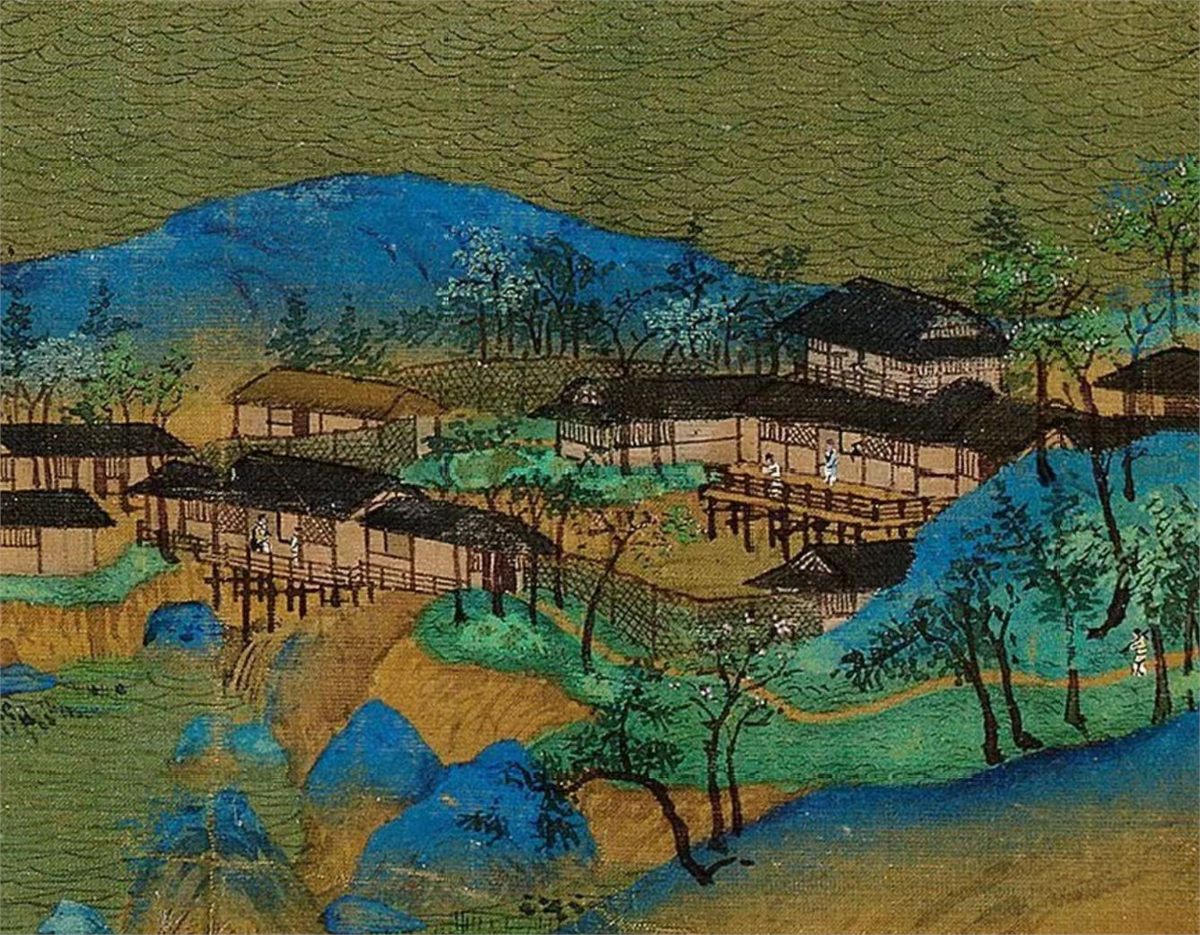
把《千里江山图》放大,舟船、桥梁、水榭、村舍、水磨,以及散落山水之间的身影才渐渐显出来。Magnify the scroll and a human world comes slowly into focus: boats and bridges, waterside pavilions, village houses and a watermill, together with figures scattered through the terrain.
人物小如豆点,却各有生活。依照服饰、动作和所处情境,可以大致辨出或理解为负笈行旅的学子、游赏山水的游人,挑担耕作的农夫,山林间的隐士,往来水陆的商贾、舟人和渔民,也有稚子与老翁。对如此细小的人物,不宜逐一强定身份;但读书、行旅、劳作、经商、渔樵、隐居与游赏,确实共同构成了画中的人间尺度。
郭熙《林泉高致》所说的“可行、可望、可游、可居”,为这种世界提供了一把钥匙。郭熙并非在评论《千里江山图》,却道出了北宋山水的一种雄心:山不只是让人远远观看,也要在想象中有路可走、有景可望、有境可游、有处可居。
这些人物连同水磨、长桥、村舍与舟船,共同构成一种关于繁荣、安定与人间有序的盛世想象:江山辽阔,百业相生,人烟与山川彼此安顿。它让人感到一个太平丰足的大宋世界,却不是北宋社会的摄影式记录。近看是人间,远看是江山;一卷之内,细微与宏阔互不相让。
到了舞台,这种比例不再由笔墨完成,而由身体与空间完成。转台与板块一次次把人物推入比自身更辽阔的天地;希孟、展卷人与群舞靠近、远去、显现、隐没。众青绿可以聚成眼前的峰,也可以转身退回群山。”希孟”与展卷人即使站在远处,也不会因此变轻——人与巨大空间的关系,本身就在说话。
画中人小,却并不卑微。正因为山河如此广大,一次赶路、一次垂钓、一叶舟,反而更像真实的人生尺度。Though tiny as specks, they are absorbed in distinct lives. From clothing, gesture and setting,
they may be read in broad terms as scholars and travellers, people out viewing the landscape, farmers
and porters at work, recluses in the mountains, merchants, boatmen and fishers, children and elders.
Figures this small should not be assigned identities too confidently; what matters is that study,
travel, labour, trade, fishing, retreat and leisure all inhabit the same landscape.
Guo Xi’s
Linquan Gaozhi (Lofty Message of Forests and Streams) offers a useful key in its ideal of landscapes
through which one might walk, look, wander and dwell. Guo Xi was not writing about A Thousand Li, but
the formulation speaks to a Northern Song ambition: a painted mountain should not merely be looked at
from afar; imagination should be able to enter it, find a path, travel through it and dwell
there.
Together with watermills, long bridges, villages and boats, these figures shape an ideal
image of prosperity, order and human habitation. The landscape suggests a peaceful and abundant Song
world without pretending to be a documentary record of Northern Song society. Seen close, it is a world
of lives; seen from afar, a world of mountains and rivers. Neither scale cancels the other.
On
stage, that relation of scale is no longer made by brush and ink but by bodies and space. Revolving
platforms and shifting panels repeatedly place the figures inside a world larger than themselves;
Ximeng, the Scroll Keeper and the ensemble approach, recede, appear and disappear. The Qinglü ensemble
can gather into a near ridge, then turn and dissolve back into the larger terrain. Even at a distance,
Ximeng and the Scroll Keeper do not become less important: their relation to the vast space is itself
expressive.
The figures in the scroll are small, but never insignificant. Against the breadth of
the landscape, a journey, an act of fishing, a single boat acquires something close to the true scale of
a human life.
历史未尽之处What History Leaves Unsaid
九百多年的距离,不必被舞台填平。The stage does not need to close nine centuries of distance.
关于“希孟“,史料记载很少;关于那些工匠,几乎没有名字。舞台可以想象,却不能假装知道。能确认的留给历史,无法确认的留给沉默;真正进入舞蹈的,是材料的重量、劳动的节奏、手卷的观看方式,以及人在山水中的尺度。
有些空白不是缺憾。正因为过去没有被讲完,今天的身体才必须更诚实地靠近。The record says little about Ximeng and preserves almost none of the names behind
the crafts and materials on which painting depended. Theatre can imagine; it should not pretend to know.
History keeps what can be established; what cannot be known is allowed to remain silent. What enters the
dance instead is the weight of materials, the rhythms of labour, the handscroll’s way of being seen, and
the scale of a human life within landscape.
Some absences do not need repairing. Because the past
remains unfinished, bodies in the present have to approach it more honestly.