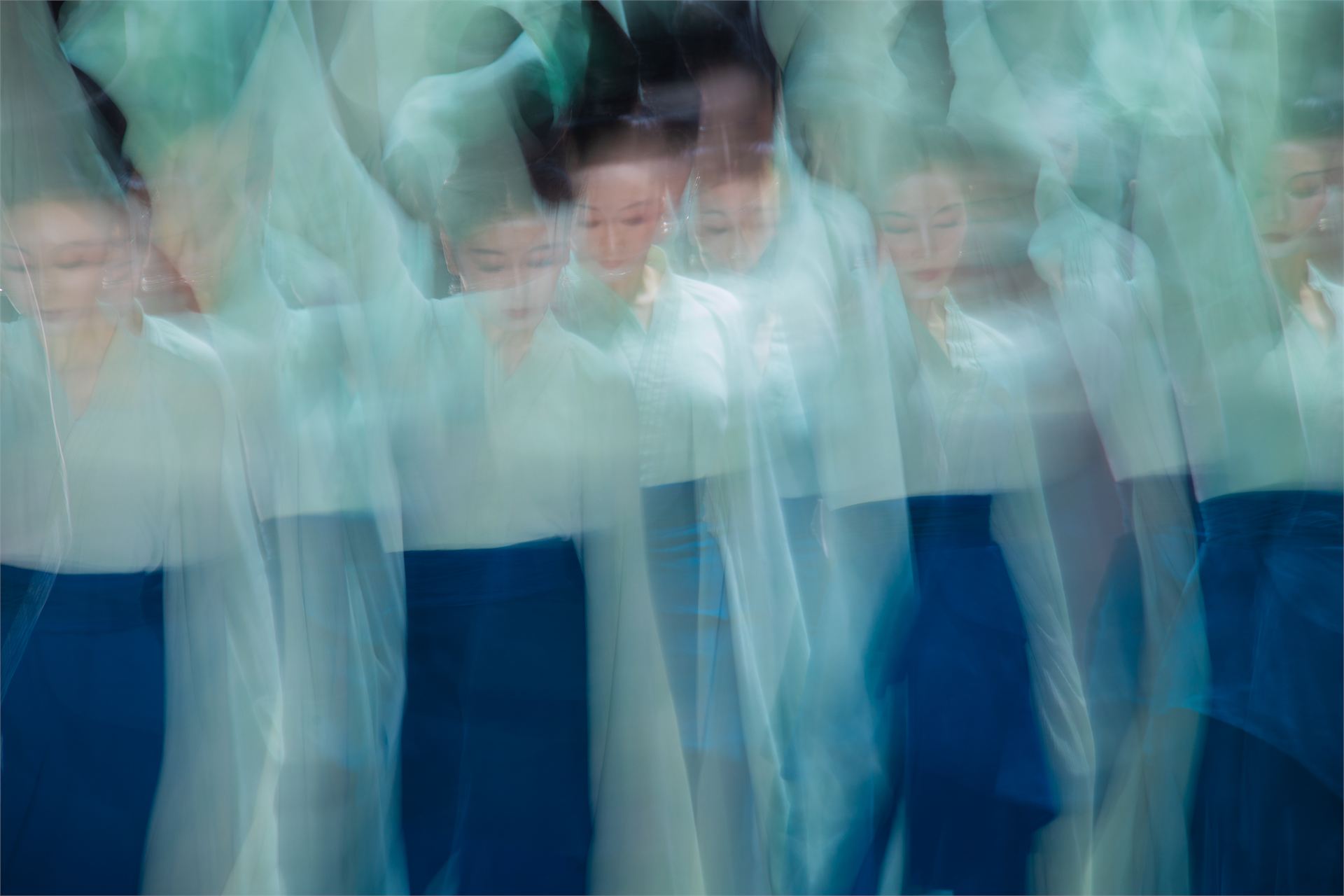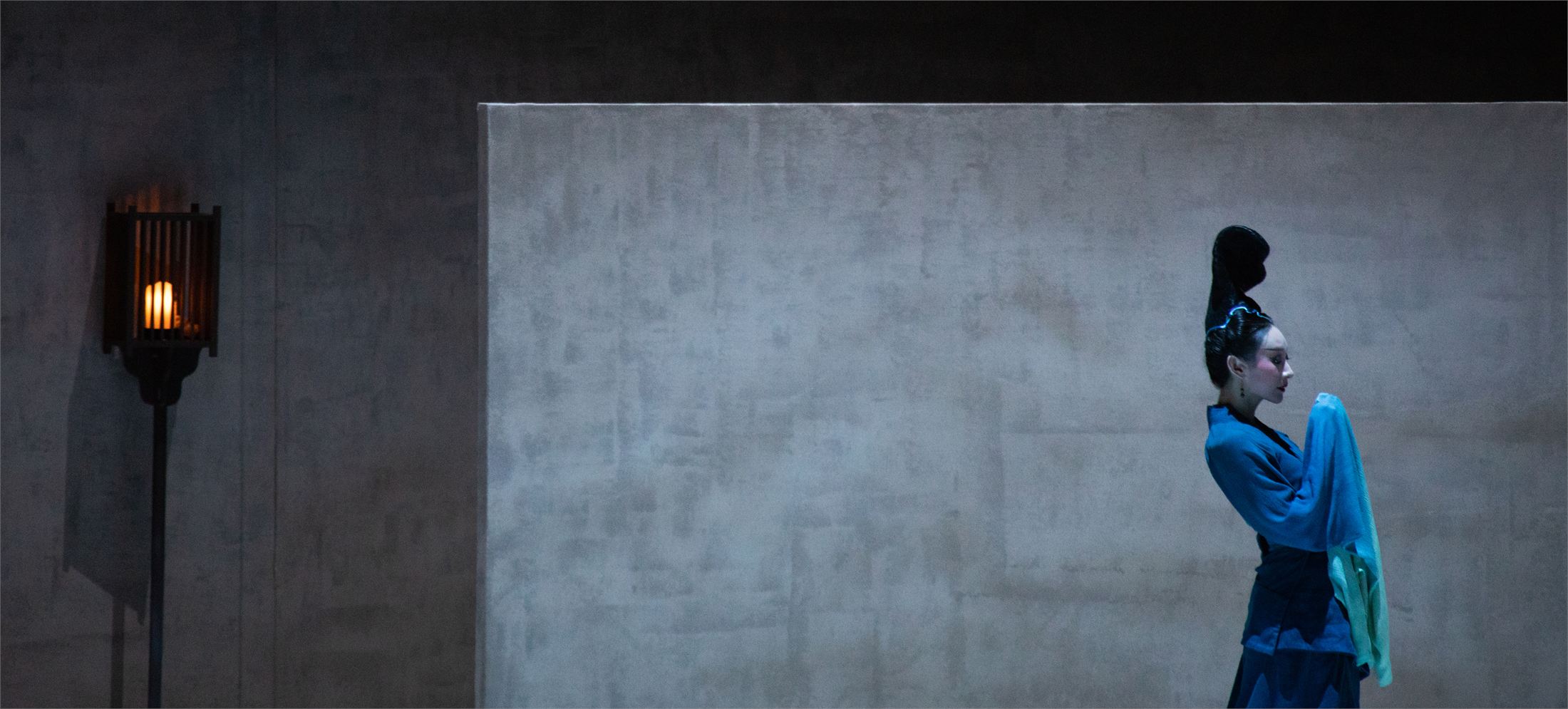
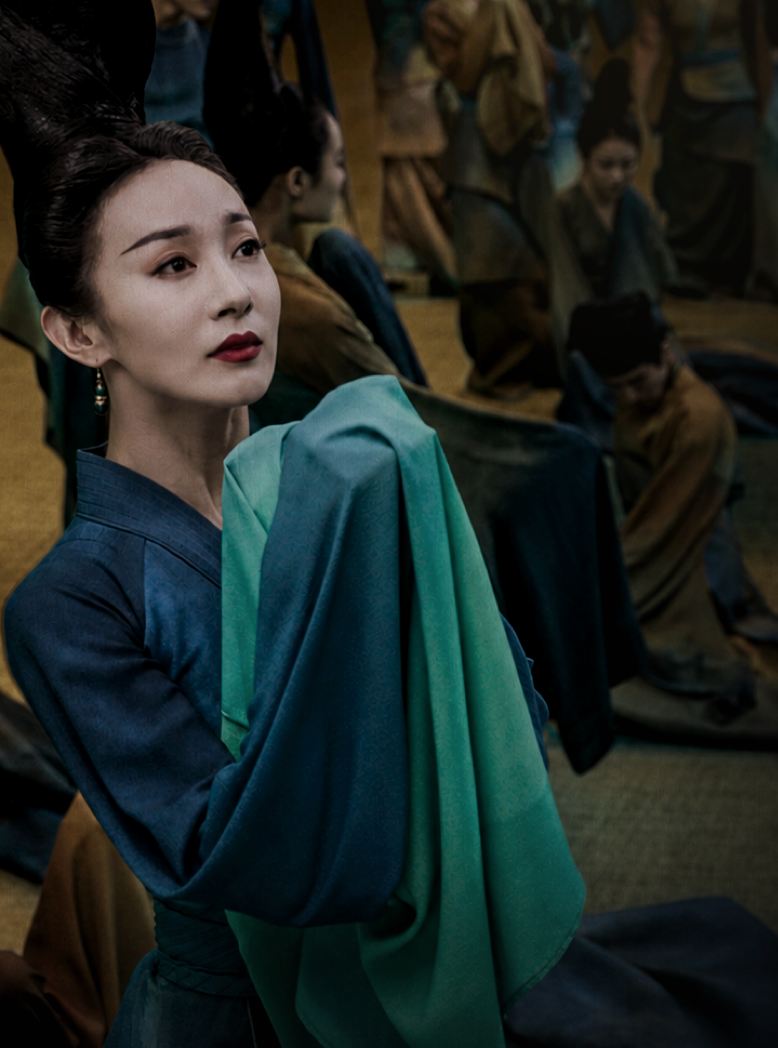
专业结构藏在身体里。观众先感到山势,然后才看见重量、线条、倾斜、距离与群体如何让它成立。Structure remains inside the body. Terrain is felt before weight, line, inclination, distance and ensemble reveal how it is made.
重量Weight
所谓“重量”,不是让舞者显得沉重,而是让观众看见身体怎样与重力和地面发生关系。Weight here does not mean heaviness. It means making the body’s negotiation with gravity and the floor perceptible.
支撑脚提供稳定的支撑面,重量在下肢、骨盆与躯干之间持续转移。上身可以显得轻,向下的承重却必须准确;越是向上延展,越需要清楚而稳定的地面支撑。
所谓“山势”,来自身体同时向下与向上的张力:重量交给地面,线条仍向空间伸展,结构因此获得可以持续的力量。
看似轻盈的部分,恰恰建立在持续而精确的重量组织之上。The feet establish the base of support while weight is continually transferred
through the lower body, pelvis and torso. The upper body may appear buoyant, but the grounding beneath
it must remain exact; extension upward depends on a clear exchange with the floor.
Terrain is not
produced by copying a mountain’s outline, but through the tension between yielding to gravity and
extending through it.
What appears light is built on continuous, precisely managed work with
weight.
垂首Lowered Gaze
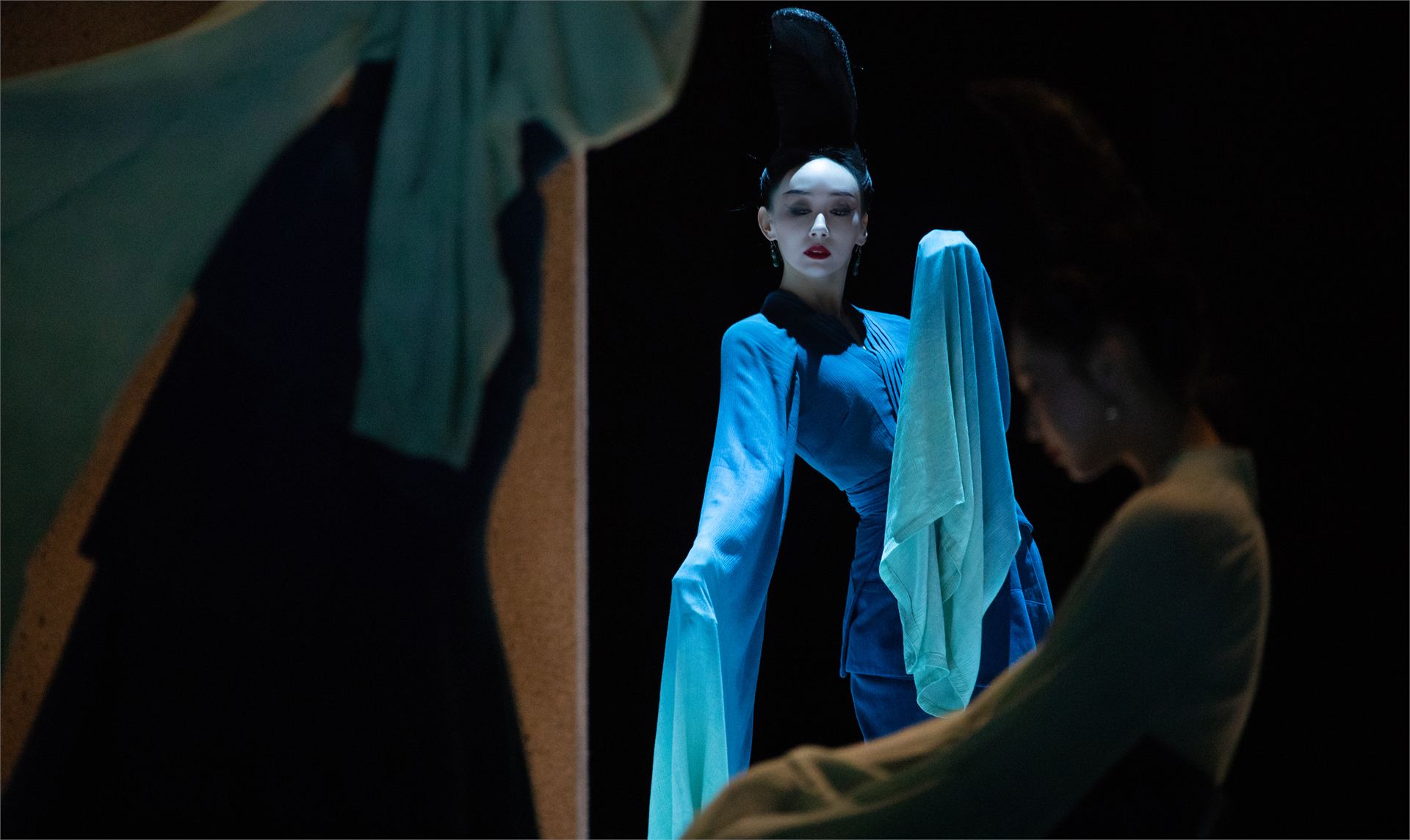
垂首改变的,不只是目光的方向,也包括头、颈与上身的整体姿态。The lowered head reorganises the upper body; it is not simply a downcast gaze.
头部轻收,会改变颈线、面部朝向与胸廓的开放程度,目光也随之内敛。正面目光与面部投射可以迅速建立舞台关系,青绿却有意收束这种前向表达;情感不首先从面部显露,而是经由身体的方向、呼吸、重量与持续时间缓缓生成。
这并非削弱表情,而是将表达的重心从面部移向全身,同时保留角色与观众之间必要的距离。Frontality and direct eye contact are powerful theatrical tools for establishing a
relationship with the audience, but Qinglü deliberately withholds both. Feeling is distributed through
direction, breath, weight and duration rather than delivered by the face first.
The effect is not
expressionlessness but a shift of expressive emphasis from the face to the whole body, while preserving
a deliberate distance from the audience.
肩背如何形成山势Line
在舞蹈语汇中,身体线条与运动轨迹分属不同层面。In dance, line and pathway are not the same thing.
身体线条,指颈、肩、背、手臂等部位在某一瞬间形成的延展、比例与方向;运动轨迹,则指身体在空间中的行进、转折与位移。青绿的“山脊感”,正是在两者的叠合中逐渐生成。
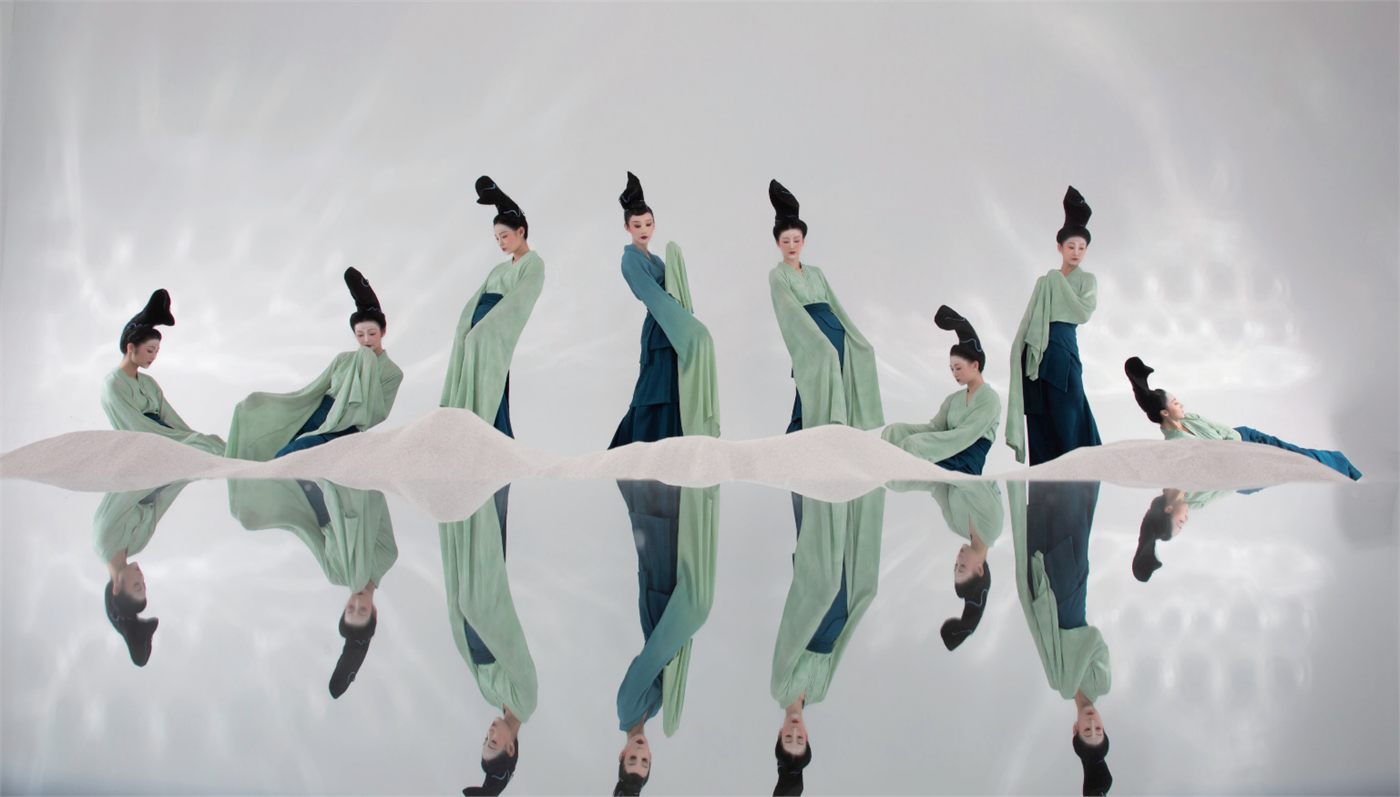
颈部的内收、肩背的展开,以及手臂与衣袖的走向,共同勾勒出折转而连绵的身体轮廓;随着重心迁移,这一轮廓的坡度、朝向与张力也随之变化。它并非对画中山形的直接摹写,而是将山势的起伏、转折、停驻与延展,转化为身体的空间经验。
因此,山势并不凝固在某一个定格之中,而是在身体的展开、停留、转向与离开之间逐渐显现。Line describes the spatial organisation, proportion and direction of the body at a
given instant; pathway describes the route a body or body part takes through space. Qinglü’s ridge-like
quality arises from their interaction.
Neck, shoulder, back, arm and sleeve form a continuous,
inflected line, while weight transfer changes its slope and direction through time. The relation to
brushwork is analogical rather than literal: brush and body are different media, but both can organise
direction, turn, pause and continuation into visible rhythm.
A still image can show a line; dance
begins in the way that line arrives, sustains itself, changes and departs.
距离Distance
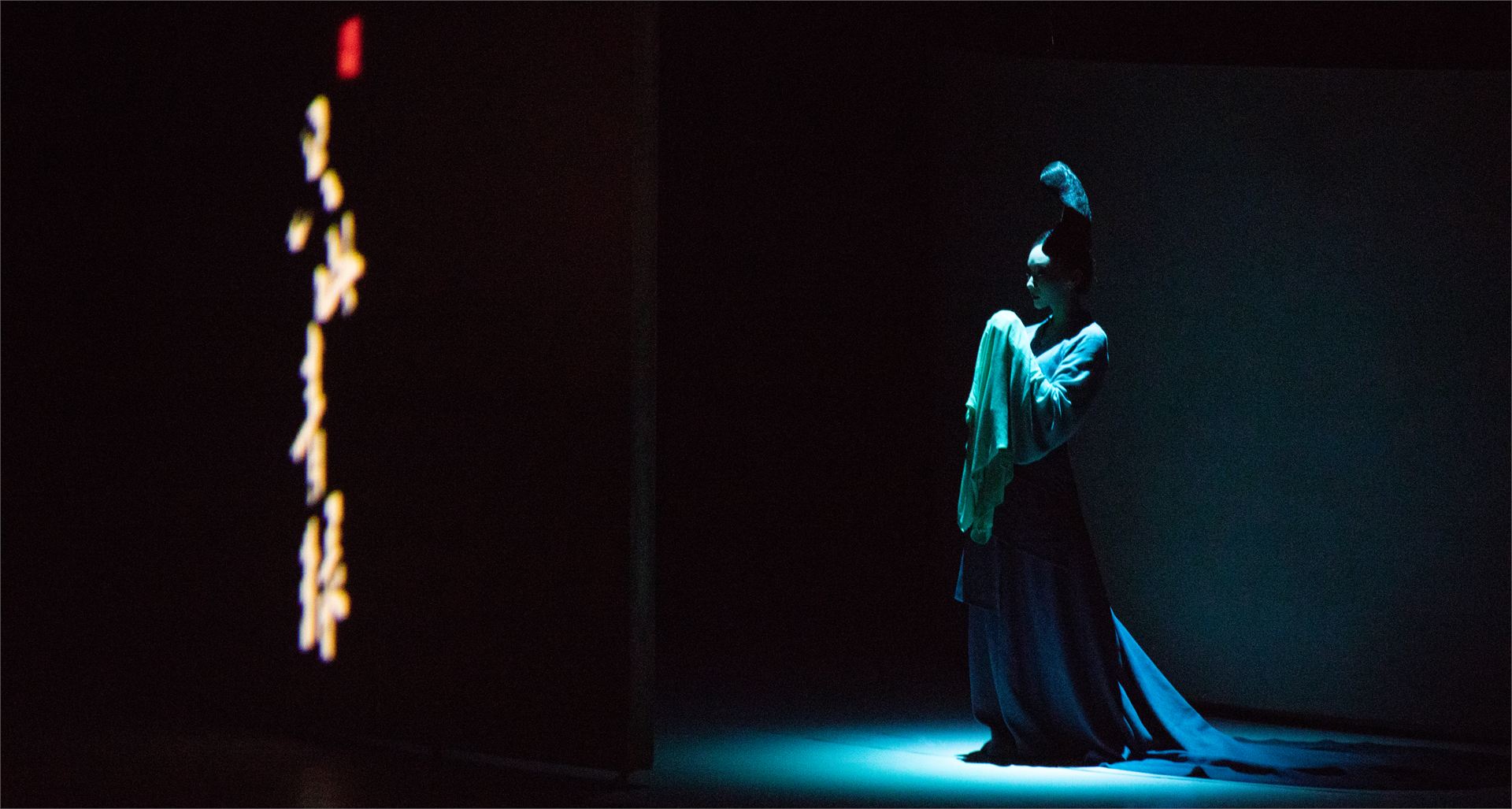
你第一次遇见“青绿”,往往先看见轮廓,而不是表情。一个身体可能从暗处出现,面容尚未完全显露;人物关系也不会在第一刻解释清楚。When Qinglü first appears, you are likely to register contour before expression. A body may emerge from darkness before the face is fully visible; relationships are not explained at once.
这样的距离不是故意藏起信息,而是把观看的次序交还给你:先看线条、呼吸、方向与空间,再让人物慢慢靠近。面容没有立刻把情绪说完,身体便留下更长的余韵;你看到的,也不只是“这个人在表达什么”,而是空间怎样改变一个人。This distance does not withhold information for its own sake. It changes the order of attention: line, breath, direction and space arrive before the figure comes closer. Because the face does not resolve feeling in advance, the body lingers longer in the eye — and we begin to notice not only what a figure expresses, but what space does to a figure.
停驻Stillness
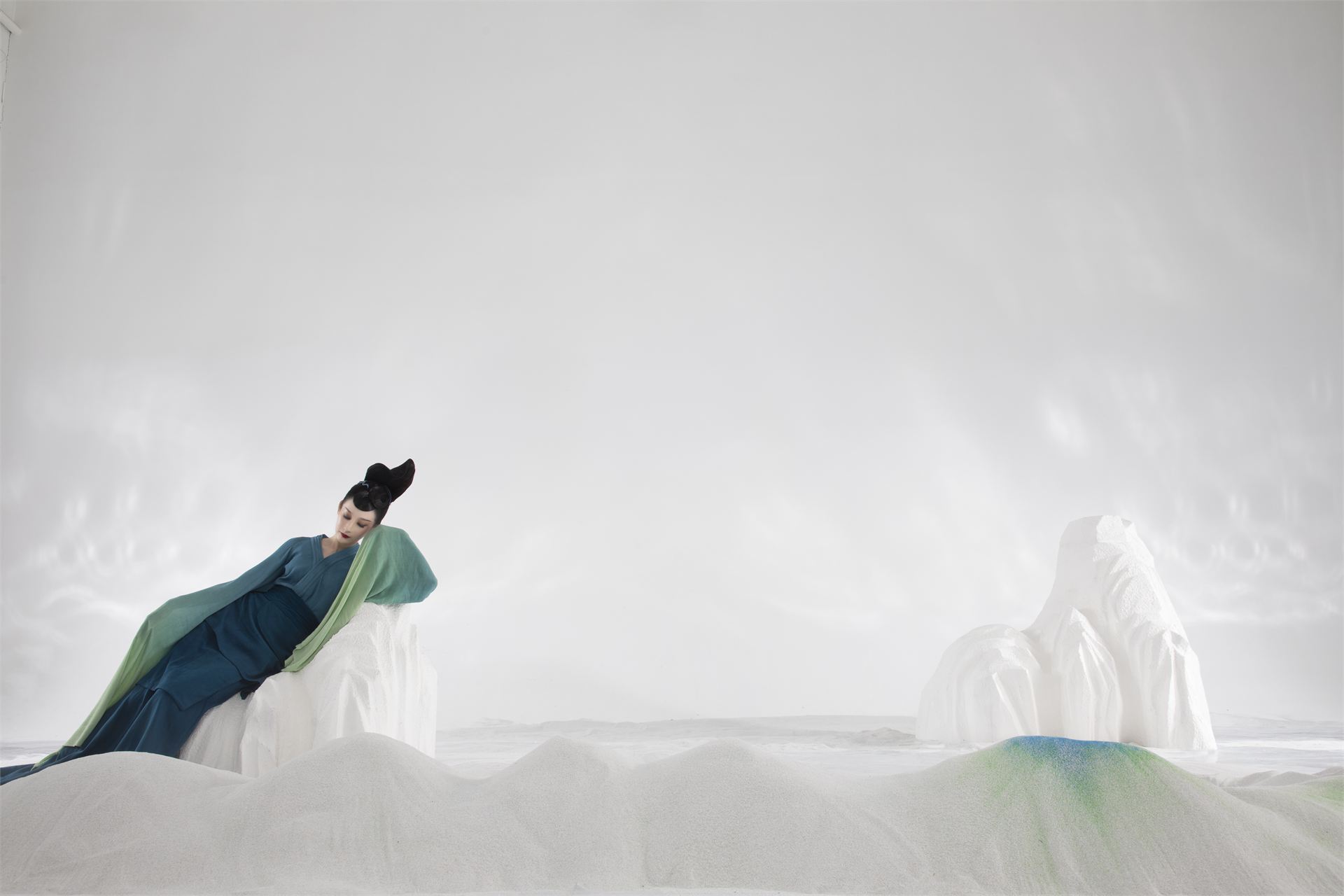
停驻不是冻结。它把原本容易被位移掩盖的身体工作放大。Sustained stillness is not immobility. It magnifies bodily work that travel can easily conceal.
身体看似不动时,平衡仍在微调,呼吸仍改变胸廓与躯干,维持姿态所需的肌张力也从未消失。位移减少以后,这些细微变化反而更容易被看见。
这种持续停驻改变的是动作的时值与注意力:重量、方向、控制和持续时间被推到前景,但运动势能并没有归零。Even when the body appears still, balance is continuously recalibrated, breath
alters the torso, and postural tone remains active. As travel diminishes, these small changes become
more perceptible.
Sustained stillness redistributes duration and attention: weight, direction and
control move to the foreground while kinetic potential remains alive.
青绿腰Qinglü Bend
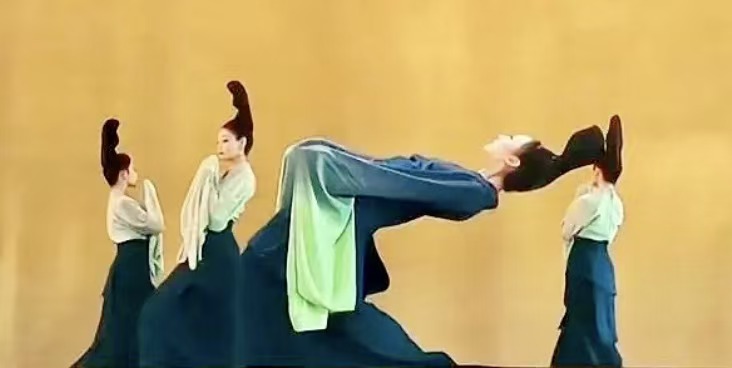
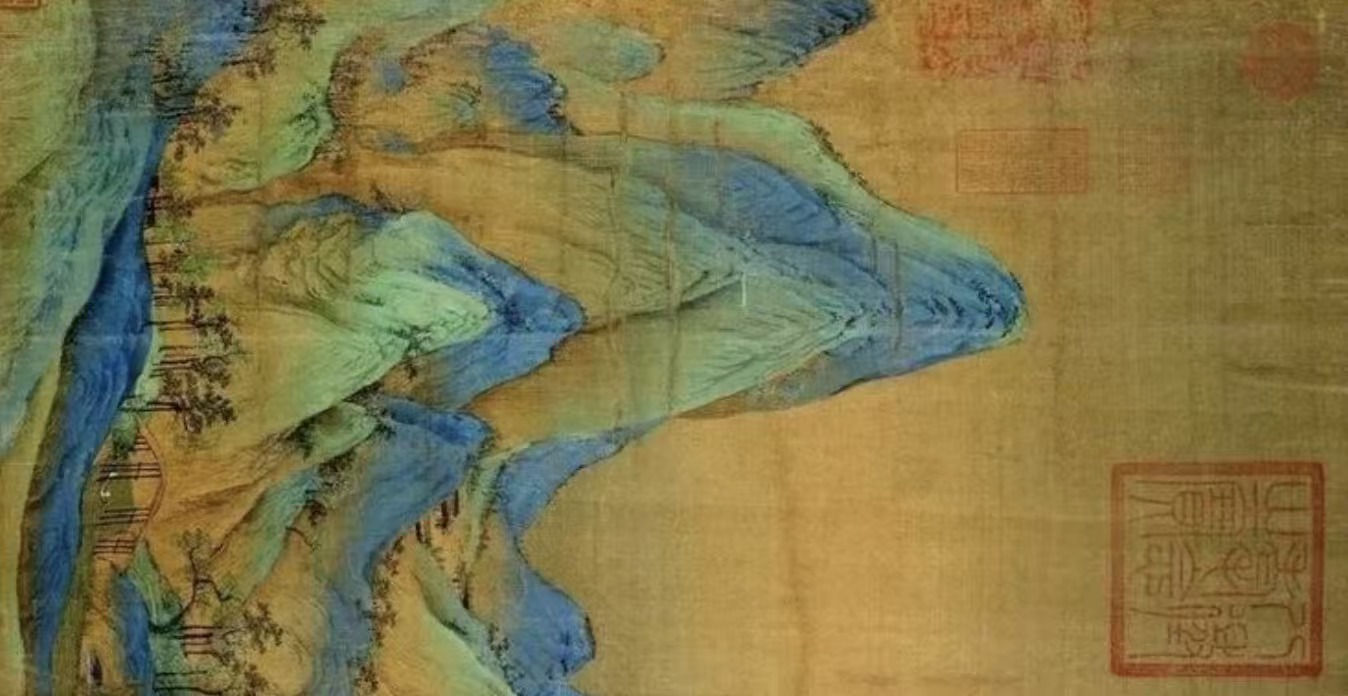
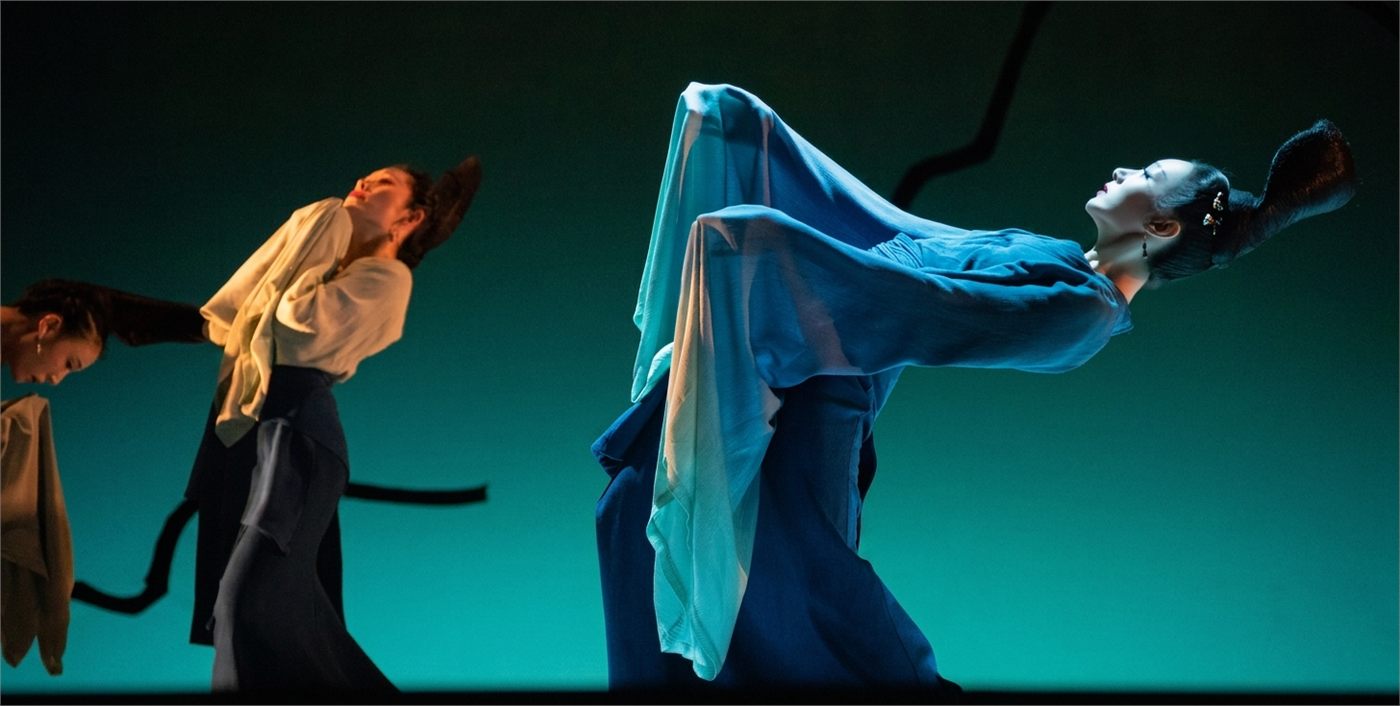
“青绿腰”不是中国古典舞传统体系中原有的规范技巧名称,而是《只此青绿》创造出的标志性舞姿与动作母题;在创作内部,它与“险峰”的意象相连。The Qinglü Bend is not the name of a pre-existing codified technique in Chinese classical dance. It is a signature pose and choreographic motif created for The Journey. Within the production, it is linked to xianfeng (险峰) — a precipitous peak.
《千里江山图》中段可见陡起、外折的峰势,与“青绿腰”向后展开形成的身体折线构成鲜明的视觉呼应。这里值得比较的是形态关系,而不是把画与舞简化成一一对应的图解。
从舞蹈技术看,它是一种大幅、持续的后仰,需要精确的离轴控制。躯干远离垂直轴时,舞者必须持续管理身体重心与支撑面的关系;视觉上越接近“将要失衡”,实际控制越依赖下肢支撑、骨盆与躯干的协调、呼吸,以及安全而准确的回收。所谓“险”,并不来自真正失控,而来自可恢复的平衡被推到视觉边缘。
两者可以并置观看,却不要把视觉相似误写成创作来源。青绿的身体在创作中本就被赋予陡峭、险峻、冷冽的山峰气质;高潮处的“青绿腰”又以极慢的时值承载悠远力量。现有创作记录并不能证明这一动作直接取自卷中某一处具体山峰。更准确的关系,是画面与身体在这里彼此照见,而不是彼此临摹。Near the middle of A Thousand Li of Rivers and Mountains, a steep peak that rises
and angles outward creates a striking visual rhyme with the backward-opening line of the Qinglü Bend.
The value of the comparison lies in formal relation, not in reducing painting and dance to a one-to-one
diagram.
Technically, the Bend is a deep, sustained back extension requiring off-axis control. As
the torso moves away from vertical, the dancer must continually manage the relationship between centre
of mass and base of support. The closer the line appears to the edge of balance, the more it depends on
lower-body support, coordination through pelvis and torso, breath, and a controlled return. Its danger
is visual, not an actual loss of control.
The two can be read in visual dialogue without turning
resemblance into a claim of direct derivation. The creative record repeatedly describes Qinglü through
steepness, severity, coldness and mountain force, while the Bend carries the climax through extreme
slowness. The surviving record does not establish that the motif was copied from any single peak in the
scroll. What matters is the resonance: painting and body illuminate one another without becoming
replicas.
群体如何构成地形Ensemble as Terrain
《千里江山图》近十二米,注定无法被一眼占有。At nearly twelve metres, A Thousand Li of Rivers and Mountains cannot be possessed in a single glance.
故宫博物院藏品页按构图把全卷大致分为六部分;从山势节奏出发,也有把它读成七组连绵群峰的方式。分法可以不同,观看经验却很一致:画卷缓缓展开,桥梁把山段连接起来,水面让视线舒展,峰峦一次次改变方向。所谓“咫尺千里”,不是夸张,而是让有限卷面容纳一场漫游。
北宋郭熙把山水空间概括为“三远”:从山下仰望山巅,是高远;从山前探入山后,是深远;从近山望向远山,是平远。三远不是三个“距离档位”,而是目光的三种方向——向上、向里、向远。《千里江山图》把多种视点穿插在同一长卷中,观看者因此不断换位:近峰抬起,层山后退,水面舒展,下一重山势又把目光带向更深处。一步一景,也一步一换视点。
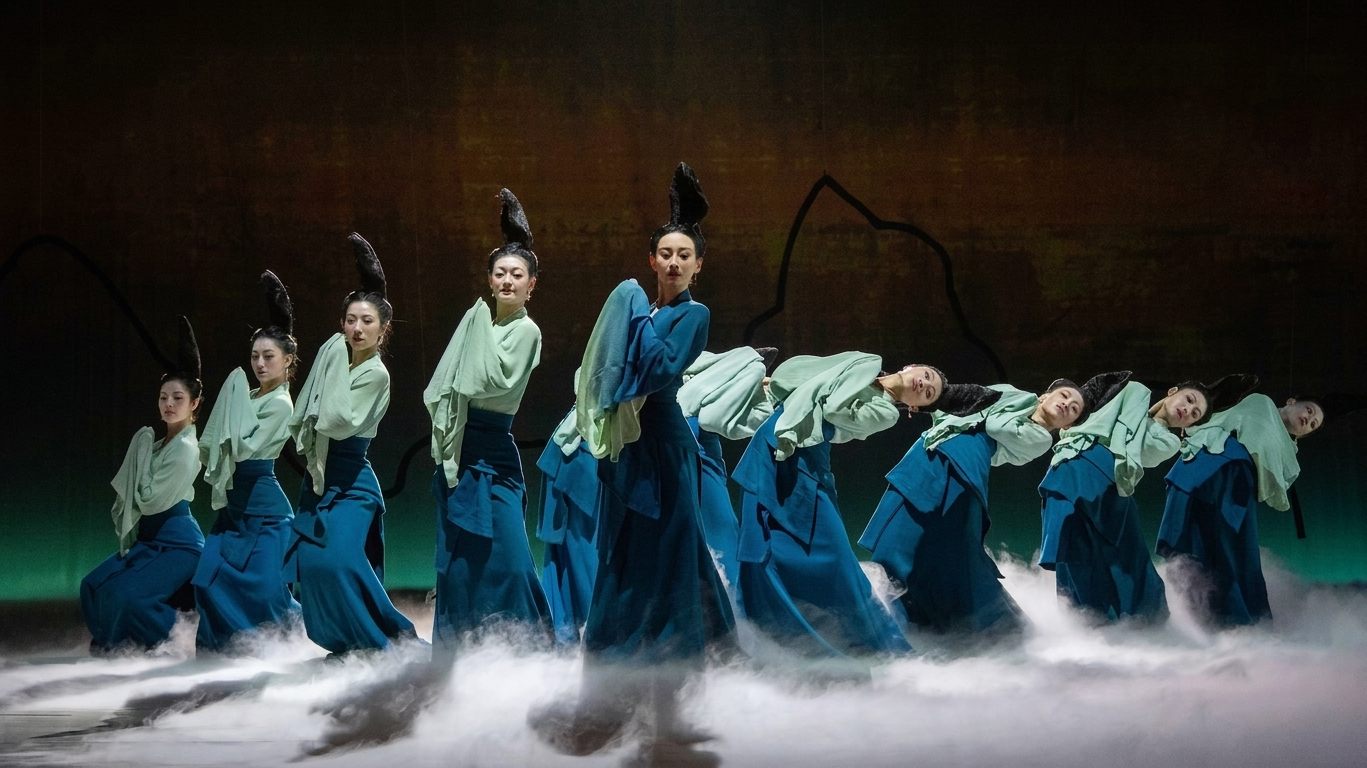
众青绿的群舞与这种观看经验相通,却不把“三远”做成舞台图解。高低、前后、间距、密度、面向、重叠与轻微错时不断改写视线:有人忽然成为近峰,有人退成远处的轮廓;领舞从群体中显现,又重新隐入山势。这里的“地形”,不是把人排成山的形状,而是让同一座舞台拥有远近、纵深与不断变化的视点。The Palace Museum describes the composition as roughly six linked sections; another
reading follows the mountain rhythm as seven successive groups. The count may vary, but the experience
is consistent: the scroll opens slowly, bridges link one terrain to another, water opens the view, and
peaks keep changing direction. The classical idea of holding “a thousand li within a few inches”
captures how a finite surface can contain the experience of travelling.
Guo Xi, the great
Northern Song painter and theorist, described three spatial modes known as the “Three Distances”: high
distance, looking upward from the foot of a mountain; deep distance, looking past the front of a
mountain into what lies behind; and level distance, looking from a near mountain toward far ones. These
are not three degrees of remoteness but three orientations of vision — upward, inward, outward. A
Thousand Li moves among them, repeatedly relocating the viewer. One scene gives way to the next; with
each opening, the eye itself has to move.
The Qinglü ensemble works by a comparable principle
without turning the Three Distances into a diagram. Levels, stage depth, spacing, density, facings,
overlap and slight temporal offsets keep rewriting where we look. A dancer can suddenly read as a near
peak; another recedes to a distant contour. The principal figure emerges, then disappears back into the
whole. Terrain here is not a mountain shape assembled from bodies. It is depth created by bodies in
time.
身体成为山势The Body Becomes Terrain
“青绿”最终不是一套动作的名字。Qinglü is not the name of a pose or a style.
她成立于一个悖论:身体越诚实地承认重力,越可能让人联想到山;一个人越少急着向外证明自我,越可能在群体与空间里获得更大的尺度。山没有向人走来。是人的身体,短暂地学会了山的时间。The figure lives inside a paradox: the more honestly the body works with gravity, the more strongly it can suggest terrain; the less insistently it declares itself, the larger it can become within ensemble and space. The mountain does not become human. For a moment, the human body learns the mountain’s time.